Tu B'Shvat for kids — a 30-minute lesson you can teach this week.
It's the trees' birthday. On Tu B'Shvat we taste the fruits of the Land of Israel, plant something, and say thank you for everything that grows. A gentle, sensory, easy-to-love holiday for young children — written for the parent who didn't grow up doing this, with every Hebrew word transliterated and no prior Hebrew needed.
When is Tu B'Shvat?
Tu B'Shvat 5787 falls on Shabbat, January 23, 2027 (it begins at sundown on Friday, January 22). It's a one-day holiday — no work restrictions — marked mostly at the table, with fruit.
Need exact times or other years? See the 5-year Jewish holiday calendar.
What is Tu B'Shvat, in 30 seconds?
Tu B'Shvat (ט״ו בִּשְׁבָט — "the 15th of Shvat") is the New Year of the Trees. Its name is just its date: the Hebrew letters ט״ו spell the number fifteen, and Shvat is the winter month it falls in. In the Land of Israel this is when the trees begin to wake up from winter and the first sap rises — so it became the trees' "birthday." We celebrate by eating fruit, especially the seven special foods the Torah praises about the Land of Israel.
For a young child, the big idea is simple:
- It's the birthday of the trees. In Israel the trees start waking up now, so we say happy birthday by eating fruit and thinking about everything that grows.
- We say thank you for fruit. Before we eat a piece of fruit we say a little blessing — a way of noticing and being grateful for the food trees give us.
That's the whole holiday at age 5: it's the trees' birthday, and we taste fruit and say thank you. The deeper ideas about caring for the earth can grow with your child. Tu B'Shvat is sweet — lead with the tasting.
The 30-minute lesson plan
Designed so you can teach it in one sitting. Adjust on the fly — younger kids need more of the hands-on parts, older kids can handle more of the story and the Hebrew.
The big idea (5 min)
Show a bare winter tree and a tree full of fruit. Say: "Today is the birthday of the trees. Far away in Israel, the trees are just starting to wake up — so we celebrate everything that grows."
Meet the seven species (10 min)
Introduce the Shivat HaMinim — the seven foods the Torah praises about the Land of Israel: wheat, barley, grapes, figs, pomegranates, olives, and dates. Lay out as many as you can find and let your child see, smell, and taste them.
Have a little Tu B'Shvat seder (5 min)
A mini-seder: taste fruits in order, and sip a little grape juice (some pour four cups, from light to dark). Talk about each fruit — which has a soft inside and hard outside, which you eat skin and all.
Plant something (5 min)
Plant a seed or a bean in a cup of soil on the windowsill, or parsley to grow in time for Pesach. Caring for a growing thing is the most concrete Tu B'Shvat lesson there is.
Say thank you (5 min)
Before the first bite of fruit, say the bracha Borei Pri HaEtz (below). On a fruit your child hasn't eaten yet this season, add Shehecheyanu — the blessing of thanks for reaching a new moment.
The blessing on fruit
One short bracha carries the whole holiday — said before eating any fruit that grows on a tree, which is exactly what Tu B'Shvat is all about.
Before eating tree fruit — Borei Pri HaEtz
בָּרוּךְ אַתָּה יְיָ אֱלֹהֵינוּ מֶלֶךְ הָעוֹלָם, בּוֹרֵא פְּרִי הָעֵץ.
Baruch atah Adonai, Eloheinu melech ha'olam, borei pri ha'etz.
Translation: Blessed are You, Lord our God, King of the universe, who creates the fruit of the tree.
On the first new fruit of the season, add Shehecheyanu — the blessing for reaching a happy new moment.
Hebrew vocabulary for this lesson
Every word your child will hear during a Tu B'Shvat lesson. Don't drill them — just point them out as they come up. After a couple of years your child will recognize them all.
| Hebrew | Pronunciation | Meaning |
|---|---|---|
| ט״ו בִּשְׁבָט | Tu B'Shvat | "The 15th of Shvat" — the New Year of the Trees |
| שִׁבְעַת הַמִּינִים | Shivat HaMinim | "The Seven Species" — the seven foods the Torah praises the Land of Israel for |
| חִטָּה | Chittah | Wheat |
| שְׂעוֹרָה | Se'orah | Barley |
| גֶּפֶן | Gefen | Grapevine (grapes) |
| תְּאֵנָה | Te'enah | Fig |
| רִמּוֹן | Rimon | Pomegranate |
| זַיִת | Zayit | Olive |
| דְּבַשׁ | Devash | Date honey — the "honey" of the seven species |
More Tu B'Shvat terms in our full Hebrew glossary →
Common questions parents ask
When is Tu B'Shvat 2027?
Tu B'Shvat 5787 falls on Shabbat, January 23, 2027, beginning at sundown on Friday, January 22. It is a one-day holiday with no work restrictions, celebrated mostly at the table with fruit.
How do I explain Tu B'Shvat to a young child?
One sentence: "Today is the birthday of the trees, so we taste fruit and say thank you for everything that grows." That's the whole lesson at age 3. Add the seven species at age 4, and the idea of caring for the earth at age 5.
What are the seven species?
Seven foods the Torah praises about the Land of Israel: wheat, barley, grapes, figs, pomegranates, olives, and dates. On Tu B'Shvat families try to taste as many as they can — dried figs, dates, raisins, and pomegranate seeds make it easy.
What is a Tu B'Shvat seder?
A short, joyful tasting at the table: you eat fruits (often grouped by whether they have a peel or a pit) and drink four small cups of grape juice that go from white to red, while talking about trees and the Land of Israel. It's a kid-favorite — all about tasting.
Do I need to know Hebrew to teach this?
No. Every Hebrew word here is transliterated, with the meaning in English. The one blessing, Borei Pri HaEtz, is short enough to read straight off the page before the first bite of fruit.
Is there a Tu B'Shvat lesson pack from Hebrew Homeschool Hub?
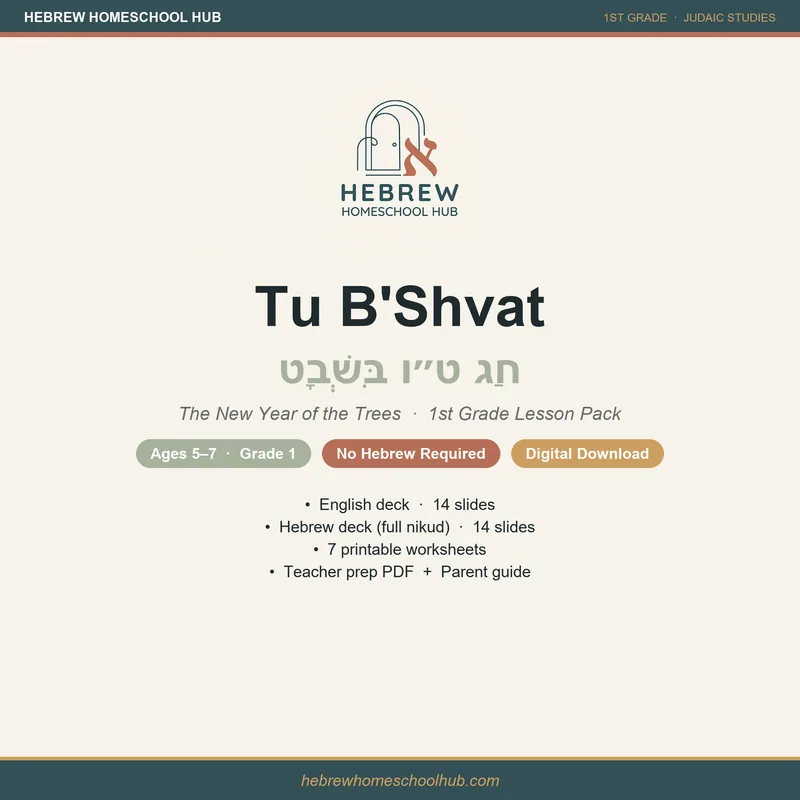
Yes — it's ready now. The Tu B'Shvat pack covers the seven species (each on its own slide), includes a kid-friendly Tu B'Shvat seder how-to in the parent guide, and ships with a vowelized Hebrew deck, worksheets, and a teacher prep PDF. See what's inside the Tu B'Shvat pack.
More from the Hub for Tu B'Shvat.
- The Tu B'Shvat lesson pack — the seven species each on its own slide, plus a kid-friendly seder how-to in the parent guide.
- Tu B'Shvat 2027 in the full calendar — exact timing in Shvat order.
- Hebrew glossary — the seven species — wheat, barley, grapes, figs, pomegranates, olives, dates, with full nikud.
- More holiday lessons in Notes from the Hub.
The Tu B'Shvat lesson pack is ready.
This free guide gets you through the first lesson. The full Tu B'Shvat pack gives you the whole holiday — an English presentation deck, the same lesson in fully vowelized Hebrew, printable worksheets, a teacher prep PDF, and an 11–12 page parent guide with 1-day and week-long lesson plans. No prior Hebrew required.