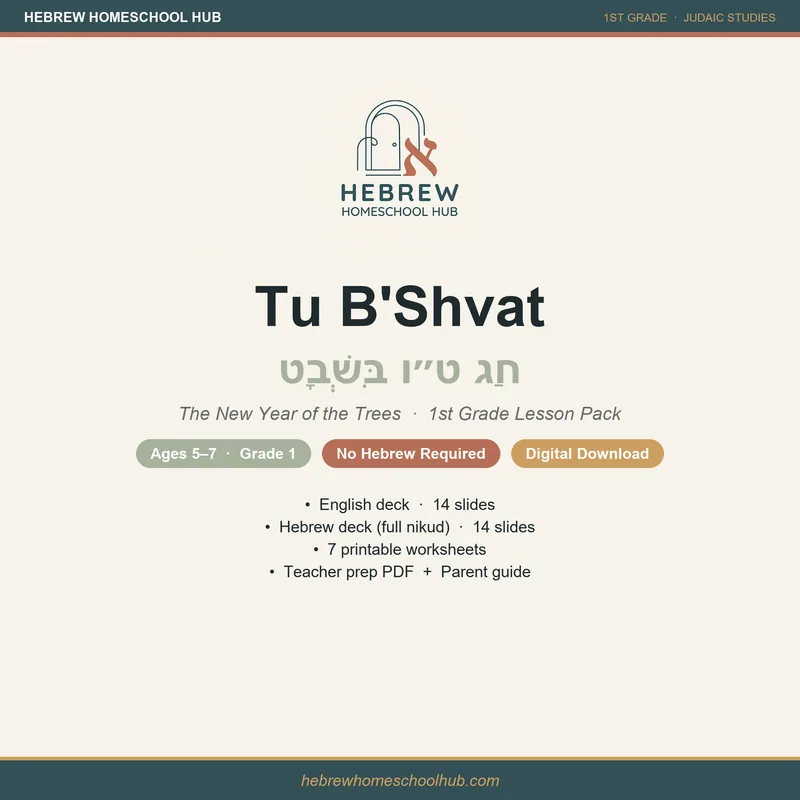
Tu B'Shvat חַג ט״ו בִּשְׁבָט
The new year for trees — including the trees and fruit your child can explore after meeting the etrog on Sukkot.
See the Tu B'Shvat pack →A week of meals in the sukkah, four special plants in a child's hands, and joy. 14 slides take your child from frame-and-walls of the sukkah to each of the four species in turn, all the way to the big finish — Hoshana Rabbah and Simchat Torah.
New: Free 30-minute lesson plan — teach Sukkot this week, then grab the pack for the full version.


Download and extract the ZIP folder. Open the printable worksheets, guides and toolkit in a PDF reader. Use PowerPoint or compatible presentation software for the lesson decks and optional worksheet editing. Print holiday worksheets on US Letter paper.
Single-family license: print for your own household. Each family in a co-op needs its own copy. The toolkit paper sizes and worksheet formats are alternate editions, not additional unique pages.
Need help? Website buyers can email hebrewhomeschoolhub@gmail.com with their product and order details. Etsy buyers can contact the shop through their order messages.
One ZIP contains 00_START_HERE_Parent_Guide.pdf (11 pages), 01_English_Deck.pptx (14 slides), 02_Hebrew_Deck.pptx (14 slides), 03_Worksheets.pptx (8 slides), 03_Worksheets_Printable.pdf (the same 8 pages), 04_Teacher_Prep_PDF.pdf (14 pages), 05_Scope_and_Sequence.pdf (1 page), the 6-page Parent Teaching Toolkit in US Letter and A4 (same content), and README.txt.
The PowerPoint files are editable; the PDFs have fixed layouts. Open the printable worksheet PDF in a PDF reader; use PowerPoint or a compatible presentation app for the lesson decks and optional worksheet editing. Hebrew font layout can vary by app; review before printing. Use US Letter paper, with an adult guiding the activities. Younger learners can participate through pictures and discussion; Hebrew tracing works best with letter familiarity. This is supplemental holiday learning for ages 5–12, not a complete reading curriculum.
License: one family. For co-op use, each family purchases its own copy. See the included README and license and delivery policy.
Slides 8–11 give each of the Arba Minim its own dedicated slide in full nikud, with what it looks like and what it teaches us:
Slide 12 then covers shaking the lulav in all six directions.
We open with the sukkah itself — what it is, how a family builds one together, why kids' decorations matter. Then we slow down for each of the four species. Finally we land in the joy of the finale: Hoshana Rabbah, Shemini Atzeret, and dancing with the Torah on Simchat Torah.
Use the English presentation and its speaker notes to lead the lesson. The separate Hebrew deck and teacher-prep notes support Hebrew-language teaching. The parent guide includes a pronunciation cheat sheet for sukkah, lulav, etrog, hadas, aravah, and the rest of the Sukkot vocabulary.
Sukkot is a tactile holiday — building, decorating, holding plants. The pack pairs naturally with whatever you do at home, from a full sukkah build to a tabletop "sukkah" made of cereal boxes.
Each of the Arba Minim gets its own slide — Hebrew name in nikud, photo, what it looks like, what it represents. Your child meets each plant one at a time, never as a confusing four-thing bundle.
No. The deck introduces the sukkah with pictures and discussion. An adult can guide the lesson whether or not your family builds a sukkah.
Yes. Slides 8–11 give the lulav, etrog, hadas, and aravah each their own dedicated slide with the Hebrew name in full nikud, what it looks like, and what it teaches us. Slide 12 covers shaking the lulav in six directions.
Slide 13 introduces Hoshana Rabbah, Shemini Atzeret, and dancing with the Torah for Simchat Torah. The worksheet deck includes a Simchat Torah flag to color.
Parents can use the English deck and its speaker notes, with pronunciation help in the parent guide. The separate Hebrew deck and teacher-prep notes are in Hebrew. Preview the lesson to check its fit for your family.
That's fine — the pack teaches the species visually and tells you what to look for when you see one. Many homeschool families teach the lesson first, then visit a community sukkah to actually hold the four species during chol hamoed.
Both pronunciations refer to the same holiday — סֻכּוֹת in Hebrew. We use "Sukkot" throughout the lesson (modern Hebrew); use whichever your family prefers when discussing it.
Sukkot and Tu B'Shvat both honor trees — the etrog is one of the four species used on Sukkot, and Tu B'Shvat is the new year for trees. Sukkot also pairs with Chanukah, since both holidays center on a mitzvah a child can touch. Tishrei sequence: Rosh Hashanah → Yom Kippur → Sukkot all fall in Tishrei: Rosh Hashanah on days 1–2, Yom Kippur on day 10, and Sukkot beginning on day 15. New: a free Rosh Hashanah for K–6 guide covers the first holiday of the month.
The new year for trees — including the trees and fruit your child can explore after meeting the etrog on Sukkot.
See the Tu B'Shvat pack →
Another hands-on holiday — lighting the chanukiah, hearing the brachot, every night for eight nights.
See the Chanukah pack →Single ZIP download for single-family use. Save and extract your files after payment is verified. A PDF reader opens the printable worksheets and guides; PowerPoint or a compatible app is needed for the lesson decks and optional worksheet editing. See our delivery policy if you need help.
Sukkot & Simchat Torah: Build, Welcome, Celebrate is a separate 19-page PDF pack for $7.98, with the same lessons in US Letter and A4. Identify the four species, make a paper sukkah, practice welcoming guests and explore the Torah reading cycle. It shares holiday themes with this $9.98 lesson pack and is a separate purchase; neither pack includes the other.
Diaspora observance. Every Sukkot begins at sundown the evening before the first listed date. For halachic questions or Israel-observance dates, see our five-year Jewish calendar or consult your rabbi.
| Year | Begins | Halachic time span |
|---|---|---|
| 2026 | Friday | Begins Friday evening, Sep 25; ends Friday night, Oct 2. (7 days) |
| 2027 | Friday | Begins Friday evening, Oct 15; ends Friday night, Oct 22. (7 days) |
| 2028 | Wednesday | Begins Wednesday evening, Oct 4; ends Wednesday night, Oct 11. (7 days) |
| 2029 | Sunday | Begins Sunday evening, Sep 23; ends Sunday night, Sep 30. (7 days) |
| 2030 | Friday | Begins Friday evening, Oct 11; ends Friday night, Oct 18. (7 days) |