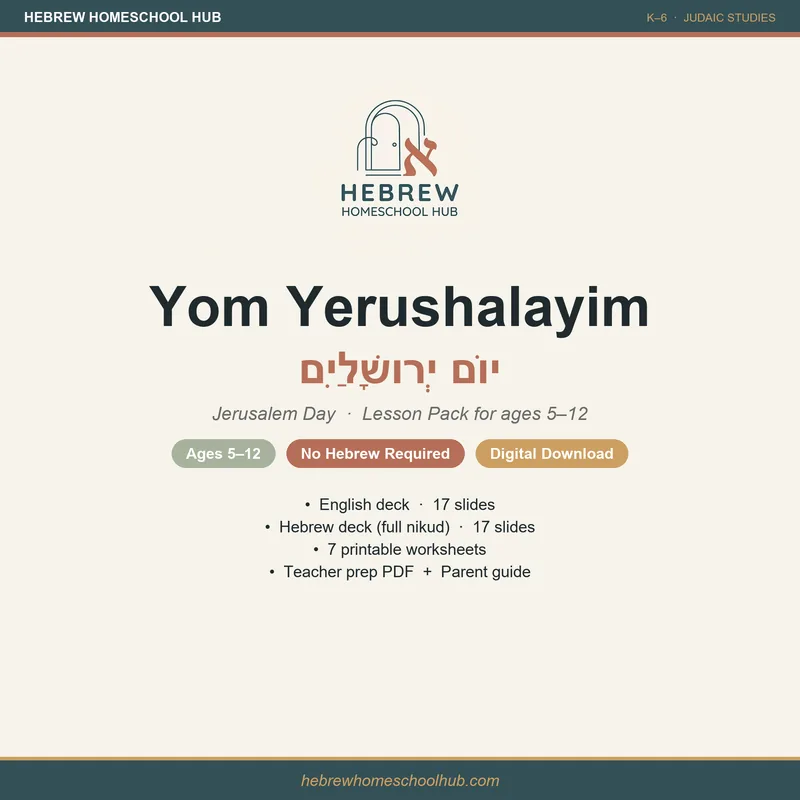
Yom Yerushalayim יוֹם יְרוּשָׁלַיִם
3 weeks later on the calendar — the natural pairing.
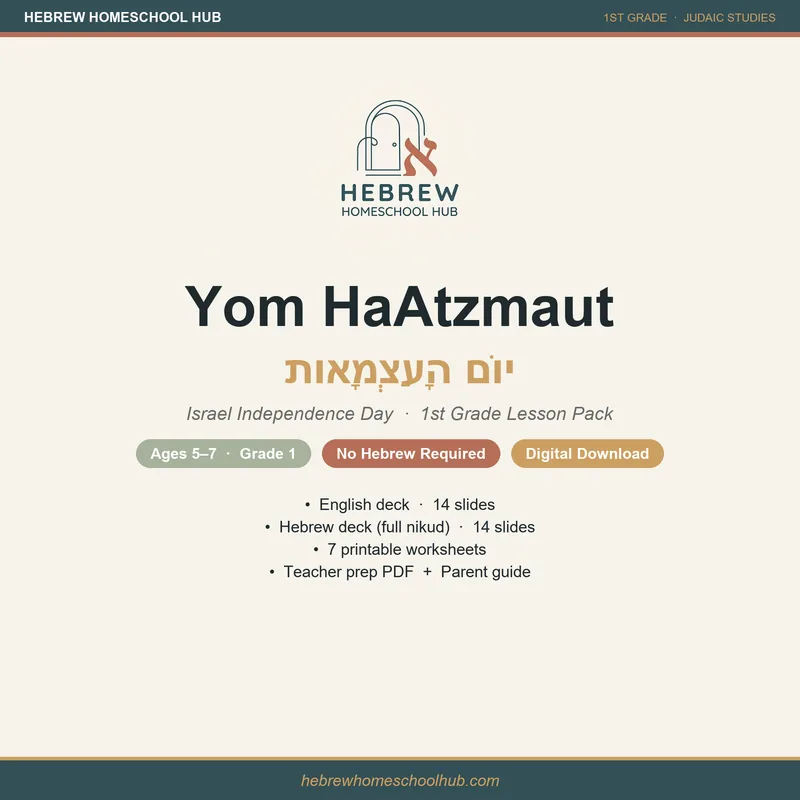
See the Yom Yerushalayim pack →After 2,000 years, the Jewish people came home — that's the arc, told for early & middle elementary learners (K–6, ages 5–12). 15 slides covering the exile, 1948, the flag, HaTikvah, and the modern miracle of Hebrew as a living language. Gentle framing: home, hope, gratitude. Never war.
New: Free 30-minute lesson plan — teach Yom HaAtzmaut this week, then grab the pack for the full version.


Download and extract the ZIP folder. Open the printable worksheets, guides and toolkit in a PDF reader. Use PowerPoint or compatible presentation software for the lesson decks and optional worksheet editing. Print holiday worksheets on US Letter paper.
Single-family license: print for your own household. Each family in a co-op needs its own copy. The toolkit paper sizes and worksheet formats are alternate editions, not additional unique pages.
Need help? Website buyers can email hebrewhomeschoolhub@gmail.com with their product and order details. Etsy buyers can contact the shop through their order messages.
Slide 7 features the opening lines of Israel's anthem in vowelized Hebrew with English translation. The speaker notes prompt you to play a recording so your child hears it sung. Tikvah — hope — is the through-line of the whole lesson.
The lesson never goes graphic about war. We focus on the 2,000-year journey home — Spain, Yemen, Russia, everywhere — and the joy of 1948 when the Jewish people had a country again. The symbols (flag, anthem, emblem) and the modern miracle of spoken Hebrew make the abstract idea of "homeland" something a 5-year-old can hold.
1948 is framed as "after 2,000 years, the Jewish people came home." A story of return and hope, not battle. Age-appropriate for early & middle elementary learners (K–6, ages 5–12).
Memorial Day is acknowledged in the parent guide with gentle language to share if your child asks — but it's not on a slide for young learners.
One of the most amazing facts in this pack: the same Hebrew that's in the Torah is the Hebrew kids in Israel use to ask for a snack. Your child will love this realization.
No. We frame 1948 as "after 2,000 years, the Jewish people came home" — a story of return and hope, not battle. The lesson is age-appropriate for early & middle elementary learners (K–6, ages 5–12).
Yes — slide 7 features the opening lines of HaTikvah in vowelized Hebrew with English translation. The speaker notes suggest playing a recording so your child hears the anthem sung aloud.
Yom HaZikaron (Israel's Memorial Day) is acknowledged in the parent guide with gentle language to share if your child asks. It is not on a slide for young learners. The parent guide gives you a 1-sentence framing in case your child overhears a siren or sees solemnity.
Quite the opposite — the pack is written for families who don't live in Israel. The whole arc is "Israel is our heart-home, even when we live far away." The early version called it "an 11-hour flight from New Jersey"; the current version generalizes to "a long plane ride from home" since our audience is geographically diffuse.
The 5th of Iyar — usually late April or early May on the secular calendar. It pairs beautifully with our Yom Yerushalayim pack, which is celebrated 3 weeks later.
It's a warm traditional pack — using traditional vocabulary (Hashem, Beit HaMikdash, Tefillah l'shlom Medinat Yisrael) while staying accessible across the observance spectrum. We don't take a position on Hallel or political readings of modern Israel.
3 weeks later on the calendar — the natural pairing.
See the Yom Yerushalayim pack →
The Maccabees' story — the ancient ancestor of "coming home to Israel."
See the Chanukah pack →Single ZIP download. Yours forever, free updates included. Single-family license.
Diaspora observance. Every Yom HaAtzmaut begins at sundown the evening before the first listed date. For halachic questions or Israel-observance dates, see our five-year Jewish calendar or consult your rabbi.
| Year | Begins | Halachic time span |
|---|---|---|
| 2026 | Tuesday | Begins Tuesday evening, Apr 21; ends Wednesday night, Apr 22. |
| 2027 | Tuesday | Begins Tuesday evening, May 11; ends Wednesday night, May 12. |
| 2028 | Monday | Begins Monday evening, May 1; ends Tuesday night, May 2. |
| 2029 | Wednesday | Begins Wednesday evening, Apr 18; ends Thursday night, Apr 19. |
| 2030 | Tuesday | Begins Tuesday evening, May 7; ends Wednesday night, May 8. |