Sukkot for kids — a 30-minute lesson you can teach this week.
A little hut with a roof of branches, four plants you get to shake in every direction, and a whole week of meals eaten under the stars. Sukkot is the coziest, happiest holiday of the Jewish year — and it's wonderfully easy to teach. Written for the homeschool parent who didn't grow up doing this: every Hebrew word transliterated, every step concrete, no prior Hebrew needed.

When is Sukkot?
Sukkot 5787 begins at sundown on Friday, September 25, 2026, and the seven days of the festival run through Friday, October 2, 2026. It rolls straight into Shemini Atzeret (Oct 2 evening – Oct 3) and Simchat Torah (Sunday, Oct 4 in the diaspora). Sukkot arrives just five days after Yom Kippur — the calendar goes from the most solemn day of the year to the most joyful in less than a week.
Need exact times or other years? See the 5-year Jewish holiday calendar.
What is Sukkot, in 30 seconds?
Sukkot (חַג סֻכּוֹת — "the Festival of Booths") is a seven-day fall harvest holiday. We build a sukkah — a temporary little hut — and live in it for the week: eating meals in it, and in many families, sleeping in it too. We do it to remember that when the Jewish people journeyed through the desert after leaving Egypt, God sheltered and cared for them. Tradition calls Sukkot z'man simchateinu, "the time of our joy."
For a 5-year-old, one idea is enough:
- We build a little house outside and live in it for a week — a cozy hut with a roof of branches you can see the stars through. It's a bit like camping at home, with God.
- We hold four special plants and wave them to say thank you for everything that grows, and to show that God is all around us — up, down, and in every direction.
That's the whole holiday at age 5: a hut and four plants. Everything else — the harvest history, the deeper meanings — can wait. Sukkot is happy. Lead with the fun.
Sukkot & Simchat Torah: Build, Welcome, Celebrate
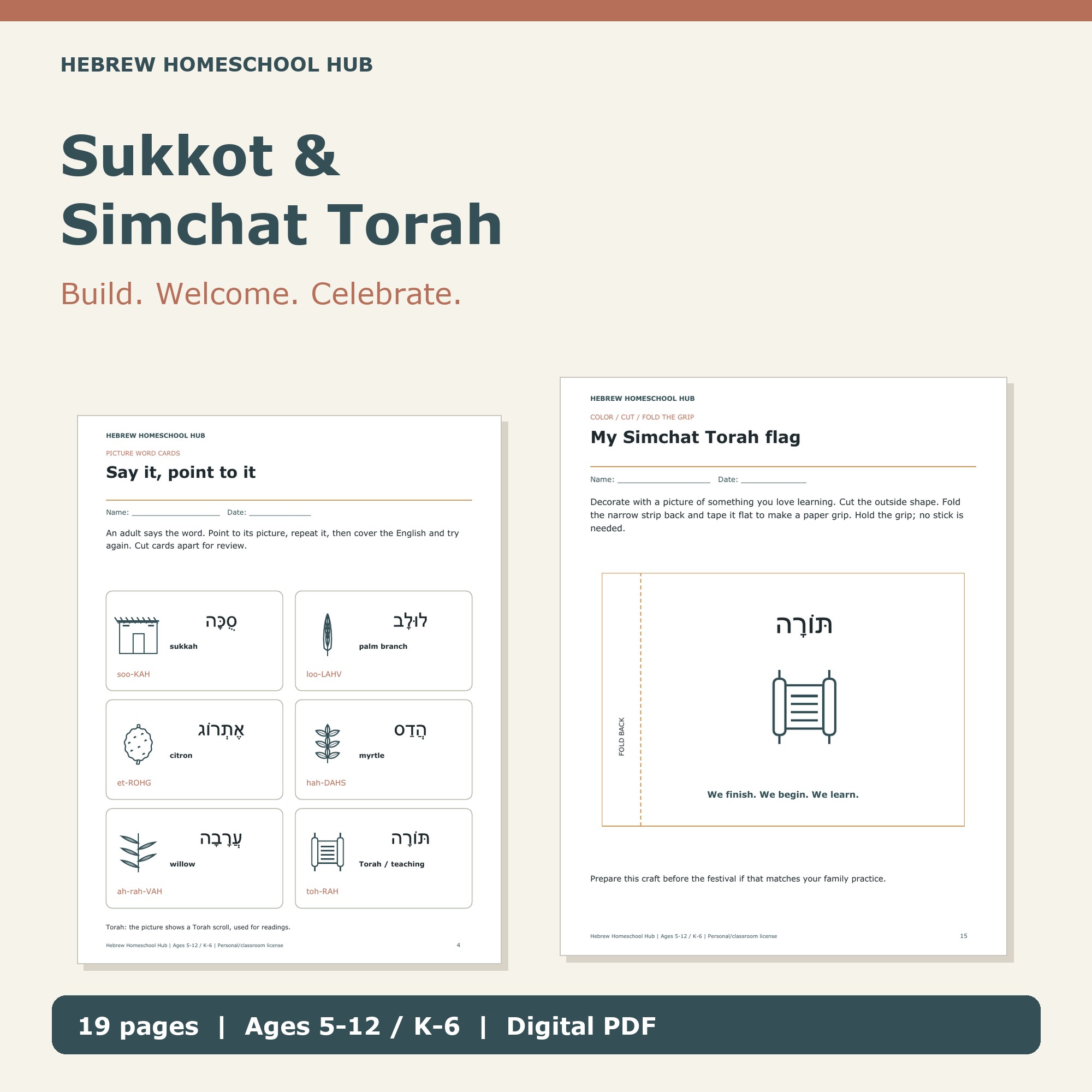
Explore the sukkah and four species, plan a warm welcome for guests, and connect Simchat Torah with beginning the Torah again.
$7.98 USD · 19 pages, including the cover, adult guide, and answers. English directions with 6 pointed Hebrew vocabulary words. Letter and A4 PDFs contain the same content. For ages 5–12 / K–6, with adult support. Digital download; no physical item.
Preview 3 pages free (PDF) · See all included activities
Download after payment, with a private link also sent to your checkout email. Keep your receipt for download support.
A separate printable activity kit that complements the $9.98 Sukkot lesson pack with English and Hebrew decks. Holiday themes and vocabulary overlap; the activity kit is a separate purchase.
The 30-minute lesson plan
Designed so you can teach it in one sitting. Adjust on the fly — younger kids = more decorating and shaking the lulav, older kids = more about the four species and the meaning of the week.
The big idea (5 min)
Show a picture of a sukkah (or your own, if you've built one). Say: "For one whole week, Jewish families eat their meals in a little hut outside, with a roof made of branches. We do it to remember that God took care of us a long time ago in the desert." Let the coziness do the work.
Build or decorate a sukkah (10 min)
Real or pretend — a backyard sukkah, or a blanket fort with leafy branches on top. The magic detail for kids is the s'chach: the roof must be cut greenery (branches, bamboo) with gaps you can see the sky through. Hang paper-chain decorations and pictures of fruit. This is the part children remember all year.
Meet the four species (5 min)
Introduce the four plants: the lulav (a tall palm branch), the etrog (a bumpy lemon-like fruit that smells amazing — let them smell it), three hadas (myrtle), and two aravah (willow). Pass them around. Each one looks and feels different.
Wave the lulav (5 min)
Hold the lulav bundle in your right hand and the etrog in your left, together. Say the blessing (below), then gently shake them in all six directions — front, back, right, left, up, and down. Tell your child: "We shake them everywhere because God is everywhere." Kids treat it like a little dance.
The big finish: Simchat Torah (5 min)
End by looking ahead to the joyful finale a week later. On Simchat Torah we finish reading the very last words of the Torah and immediately start again from the beginning — and we dance around the room holding the Torah scrolls. "We love the Torah so much we never stop reading it."
The two Sukkot blessings
Two short brachot carry the whole holiday: one for eating in the sukkah, one for waving the four species. Both are in full Hebrew with transliteration and meaning — read them right off the page.
Eating in the sukkah — Leishev BaSukkah
בָּרוּךְ אַתָּה יְיָ אֱלֹהֵינוּ מֶלֶךְ הָעוֹלָם, אֲשֶׁר קִדְּשָׁנוּ בְּמִצְוֹתָיו וְצִוָּנוּ לֵישֵׁב בַּסֻּכָּה.
Baruch atah Adonai, Eloheinu melech ha'olam, asher kid'shanu b'mitzvotav v'tzivanu leishev ba'sukkah.
Translation: Blessed are You, Lord our God, King of the universe, who has sanctified us with His commandments and commanded us to dwell in the sukkah.
Said over bread/food the first time you eat in the sukkah each day.
Waving the four species — Al Netilat Lulav
בָּרוּךְ אַתָּה יְיָ אֱלֹהֵינוּ מֶלֶךְ הָעוֹלָם, אֲשֶׁר קִדְּשָׁנוּ בְּמִצְוֹתָיו וְצִוָּנוּ עַל נְטִילַת לוּלָב.
Baruch atah Adonai, Eloheinu melech ha'olam, asher kid'shanu b'mitzvotav v'tzivanu al netilat lulav.
Translation: Blessed are You, Lord our God, King of the universe, who has sanctified us with His commandments and commanded us concerning the taking of the lulav.
Said the first time you take the four species each day of Sukkot (except Shabbat). On the very first day, add the Shehecheyanu blessing of thanks.
Hebrew vocabulary for this lesson
Every word your child will hear during a Sukkot lesson. Don't drill them — just point them out as they come up. After a couple of years your child will recognize them all.
| Hebrew | Pronunciation | Meaning |
|---|---|---|
| חַג סֻכּוֹת | Chag Sukkot | "The Festival of Booths" — the seven-day fall holiday |
| סֻכָּה | Sukkah | The temporary hut we build and eat in for the week |
| סְכָךְ | S'chach | The roof of cut branches — you should see the stars through it |
| לוּלָב | Lulav | Palm branch — one of the four species |
| אֶתְרוֹג | Etrog | Citron — the lemon-like fruit with a wonderful smell |
| הֲדַס | Hadas | Myrtle — three branches in the bundle |
| עֲרָבָה | Aravah | Willow — two branches in the bundle |
| אַרְבַּעַת הַמִּינִים | Arba'at HaMinim | "The four species" — lulav + etrog + hadas + aravah, waved together |
| הוֹשַׁעְנָא רַבָּא | Hoshana Rabbah | The seventh day of Sukkot — many willows, many prayers |
| שְׁמִינִי עֲצֶרֶת | Shemini Atzeret | "Eighth-day assembly" — the holiday right after Sukkot |
| שִׂמְחַת תּוֹרָה | Simchat Torah | "Joy of the Torah" — we finish and restart the Torah and dance with it |
More Sukkot terms in our full Hebrew glossary →
Common questions parents ask
How do I explain Sukkot to a really young child (3–5)?
One sentence: "We build a little hut outside and eat in it for a week, because it's a happy holiday and we're saying thank you to God." That's the whole lesson at age 3. Add the four species at age 4. Add the "remembering the desert" reason at age 5. The holiday repeats every fall — the depth grows year by year.
Do we have to build a sukkah, or sleep in it?
The mitzvah is to "dwell" in the sukkah — mostly that means eating your meals in it for the week, and some families also sleep in it. For a first K–6 lesson you don't need a real sukkah at all: a blanket fort with a leafy roof, or a picture and a craft, teaches the idea perfectly. If you do build one, the part kids love most is the s'chach roof you can see the stars through.
Where do I get the four species?
Most families buy a lulav-and-etrog set ("the four minim") from a Judaica store, a synagogue, or online in the two to three weeks before Sukkot. A basic set is inexpensive and reusable for the lesson even after the holiday. No set on hand? Pictures work fine for a first lesson — point out the tall palm, the bumpy yellow etrog, the small myrtle leaves, and the long thin willow.
Which direction do you wave the lulav?
Hold the bundle and etrog together and shake gently in all six directions — front, back, right, left, up, and down (different communities use slightly different orders; any is fine for a child). The idea is simple and beautiful: God is in every direction, all around us. Say the Al Netilat Lulav blessing first; on the very first day, add Shehecheyanu.
Is there a Sukkot lesson pack from Hebrew Homeschool Hub?
Yes — and it's ready now. The Sukkot pack is a complete, done-for-you week: a 14-slide English deck, the same lesson in fully vowelized Hebrew, a printable worksheet pack, a teacher prep PDF, and an 11–12 page parent guide. It walks through the sukkah from frame to decorations, all four species (each on its own slide), waving the lulav in six directions, and the finale — Hoshana Rabbah, Shemini Atzeret, and Simchat Torah. See what's inside the Sukkot pack →
Can I use this in a co-op or Sunday school?
Yes — this free guide works in any K–6 learning context (homeschool, co-op, Hebrew school, Sunday school, or family at the table). If you'd like the full multi-day curriculum with slides, worksheets, and a parent guide, that's the Sukkot lesson pack (single-family license; co-ops should have each family buy their own copy).
More from the Hub for Sukkot.
- The Sukkot lesson pack — the whole week, done for you: English + vowelized Hebrew decks, worksheets, teacher prep PDF, and parent guide.
- Sukkot 2026 in the full calendar — exact halachic times for the festival, Shemini Atzeret, and Simchat Torah, with all the Tishrei holidays in order.
- Friday-night candle lighting times — Sukkot eve 2026 falls on a Friday, so Shabbat and yom tov candles overlap. Look up your city.
- Hebrew glossary — Sukkot terms — sukkah, lulav, etrog, and the rest, with full nikud.
- Rosh Hashanah for kids and Yom Kippur for kids — the High Holidays that lead right into Sukkot, five days later.
The Sukkot lesson pack is ready.
This free guide gets you through the first lesson. The full Sukkot pack gives you the entire holiday — a 14-slide English deck, the same lesson in fully vowelized Hebrew, printable worksheets, a teacher prep PDF, and an 11–12 page parent guide with 1-day and week-long lesson plans. No prior Hebrew required.