Yom Yerushalayim for kids: a 30-minute lesson plan you can teach tonight.
Yom Yerushalayim — Jerusalem Day, יוֹם יְרוּשָׁלַיִם — is on the 28th of Iyar (May 17, 2026). It's the day Jewish families remember when, after almost 2,000 years of waiting, the Jewish people could once again visit the Kotel — the Western Wall — in the heart of the Old City of Jerusalem. This post is a free lesson plan for K–6 homeschool families. Use it as-is, or grab the complete 17-slide Yom Yerushalayim lesson pack if you want everything ready to teach.
Posted May 13, 2026 · Reading time: ~8 minutes · Lesson time: ~30 minutes
What is Yom Yerushalayim, in one paragraph?
Yom Yerushalayim (יוֹם יְרוּשָׁלַיִם, "Jerusalem Day") commemorates the reunification of the city of Jerusalem in 1967. For nineteen years before that — from 1948 to 1967 — the Old City of Jerusalem (including the Kotel, the Western Wall) was inaccessible to Jewish families. Yom Yerushalayim is the day we mark when that long wait ended. It falls on the 28th of Iyar. In 2026 that's Sunday, May 17.
The story arc to use with K–6 kids
For young children, you don't need military history. You need the human arc: longing → return → joy. Here's the version we use in the lesson pack, condensed:
- Long ago in Jerusalem, the Beit HaMikdash (בֵּית הַמִּקְדָּשׁ) — the Holy Temple — stood at the heart of the city. Inside it burned a golden menorah every single day.
- The Temple was destroyed, and for almost 2,000 years Jewish families lived all over the world — Spain, Yemen, Russia, Morocco, America. Every single day, three times a day, they prayed: "Next year in Jerusalem."
- In 1948, the Jewish people had a country again — Israel. But the Old City of Jerusalem, where the Beit HaMikdash had stood, was just out of reach. Families could see the walls in the distance. They could not visit the Kotel.
- For 19 years, this was true. A grandparent who lived in West Jerusalem could stand on a rooftop and see the Old City a few blocks away — and not be allowed to enter.
- Then, in 1967, something changed. The Old City was reunified with the rest of Jerusalem. Jewish families could finally — finally — walk to the Kotel and pray. People sang. People cried. Grandparents who had said "Next year in Jerusalem" their whole lives finally stood at the Wall.
That's the lesson. Notice what we leave out: weapons, dates of battles, the names of armies. None of that belongs in a K–6 Jewish Studies lesson. The arc is what matters: 2,000 years of longing, and then — finally — return. A 6-year-old can hold this.
A 1-line framing if your child asks "how did it happen?"
"After many years, the people who weren't letting Jewish families visit weren't there anymore, and the Jewish families could finally walk through the gates and pray at the Kotel." That's age-appropriate. Save the harder pieces for when they're older.
The 8 gates of the Old City — and why we teach them
The Old City of Jerusalem is surrounded by a wall, and that wall has eight gates. Each gate has its own Hebrew name, its own purpose, and its own story. Teaching the gates is one of the most effective ways to make Yom Yerushalayim concrete for a young child — each gate is a doorway, each doorway has personality. By the end of one lesson, a 1st grader can name them all.
| Gate (English) | Hebrew name | What to tell a kid |
|---|---|---|
| Jaffa Gate | שַׁעַר יָפוֹ | The western gate. Most pilgrims and tourists arrive here first. |
| Zion Gate | שַׁעַר צִיּוֹן | Opens onto Mount Zion. King David's tomb is just outside. |
| Dung Gate | שַׁעַר הָאַשְׁפּוֹת | The closest gate to the Kotel. Funny name; long history. |
| Golden Gate | שַׁעַר הָרַחֲמִים | Sealed shut for hundreds of years. Tradition says it will reopen when Mashiach comes. |
| Lions' Gate | שַׁעַר הָאֲרָיוֹת | Guarded by carved lions on the wall above the gate. |
| Herod's Gate | שַׁעַר הַפְּרָחִים | Also called "Gate of Flowers" because of the rosettes carved above the arch. |
| Damascus Gate | שַׁעַר שְׁכֶם | The biggest and most beautiful. You enter the Muslim Quarter through here. |
| New Gate | הַשַּׁעַר הֶחָדָשׁ | The newest of the eight, only about 135 years old. |
If you have 30 minutes, pick four gates and tell their stories. (Our recommendation: Jaffa, Dung, Golden, and Lions' — they cover geography, the Kotel, the Mashiach tradition, and the city's history all in one sweep.) If you have a half-day, do all eight. The Yom Yerushalayim pack has one slide per gate with a real photograph, the Hebrew name with full nikud, and a kid-friendly fact.
The 30-minute lesson outline
Here's a complete lesson you can teach tonight with no other materials. If your child is closer to age 5, lean on the storytelling. If closer to 7 or 8, give them the gates in writing to trace.
0:00 — Open with a question (3 min)
Ask your child: "Have you ever waited a really, really long time for something?" Let them answer. The longer the wait, the better the example. Then say: "Today's special holiday is about a wait that lasted almost 2,000 years."
3:00 — What is Yom Yerushalayim? (5 min)
Point Jerusalem out on a map or globe. (If you don't have a globe, even a printed world map works.) Tell them: "This city is called Yerushalayim — Jerusalem. It's the most important city in Jewish history. Today is a day we celebrate when the Jewish people could finally come back to one special part of it."
8:00 — The story (7 min)
Tell the arc from the section above — longing, return, joy. Speak softly during the longing parts; speak warmly during the return. The pace is the lesson: the long story doesn't get shortcuts.
15:00 — Meet 4 of the 8 gates (7 min)
Pick four gates and tell their stories one at a time. Show photos if you have a screen. (Wikipedia has a beautiful gate gallery; or use the pack's slides.) Pause after each gate to let the name sink in.
22:00 — The Kotel (5 min)
Tell your child: "The Kotel — also called the Western Wall — is a piece of the wall that surrounded the Beit HaMikdash 2,000 years ago. It's the closest place in the world to where the Beit HaMikdash stood. Today, families from all over the world come to the Kotel to pray. Some people write a little note with a prayer and slip it between the stones." If you have time, you and your child can write one together.
27:00 — Sing & close (3 min)
Sing "L'shanah haba'ah b'Yerushalayim" — "Next year in Jerusalem" (לְשָׁנָה הַבָּאָה בִּירוּשָׁלָיִם) — the line we say at the end of every Pesach seder, and at the end of Yom Kippur. Tell your child: "For 2,000 years our families said this every year. And then one year — they were there."
Hebrew vocabulary to introduce
| Word | Hebrew | Say it like |
|---|---|---|
| Yerushalayim (Jerusalem) | יְרוּשָׁלַיִם | yi-roo-sha-LAH-yim |
| Sha'ar (gate) | שַׁעַר | SHA-ar |
| Kotel (Western Wall) | כֹּתֶל | KO-tel |
| Beit HaMikdash (Holy Temple) | בֵּית הַמִּקְדָּשׁ | bayt ha-MIK-dahsh |
| Ir HaKodesh (Holy City) | עִיר הַקֹּדֶשׁ | eer ha-KO-desh |
| Mashiach (Messiah) | מָשִׁיחַ | ma-SHEE-akh |
| L'shanah haba'ah b'Yerushalayim (Next year in Jerusalem) | לְשָׁנָה הַבָּאָה בִּירוּשָׁלָיִם | luh-sha-NAH ha-ba-AH bee-ru-sha-LA-yim |
One song every Jewish child should know — Yerushalayim Shel Zahav
"Yerushalayim Shel Zahav" (יְרוּשָׁלַיִם שֶׁל זָהָב, "Jerusalem of Gold") was written by Naomi Shemer in May 1967. Shemer wrote it in the weeks before the reunification, and within a month of its first performance, Jerusalem was reunified. Israeli paratroopers sang it at the Kotel. It became, overnight, the song of the moment — and remains one of the most beloved Jewish songs ever written.
The opening lines:
אֲוִיר הָרִים צָלוּל כַּיַּיִן
וְרֵיחַ אֳרָנִים
נִשָּׂא בְּרוּחַ הָעַרְבַּיִם
עִם קוֹל פַּעֲמוֹנִים
"The mountain air is clear as wine,
And the scent of pines
Is carried on the evening breeze
With the sound of bells…"
Play a recording for your child if you can — there are beautiful versions on YouTube. The song is gentle enough for a 5-year-old to listen to. The melody is what they'll remember.
What if my child asks the hard question?
Sometimes a child asks: "Why couldn't the Jewish families visit before? What happened in 1967?"
Here's the framing we suggest:
"For a long time, the people in charge of the Old City wouldn't let Jewish families in. Then in 1967, things changed, and the Jewish families could walk through the gates and pray at the Kotel for the first time in a very long time. It was a big, big moment. People sang and cried with happiness."
That's accurate. It's age-appropriate. It doesn't sanitize history out of recognition, but it doesn't require a 1st grader to understand a war. Save the harder pieces for when your child is older and asks specific questions.
Want the full version, all set up for you?
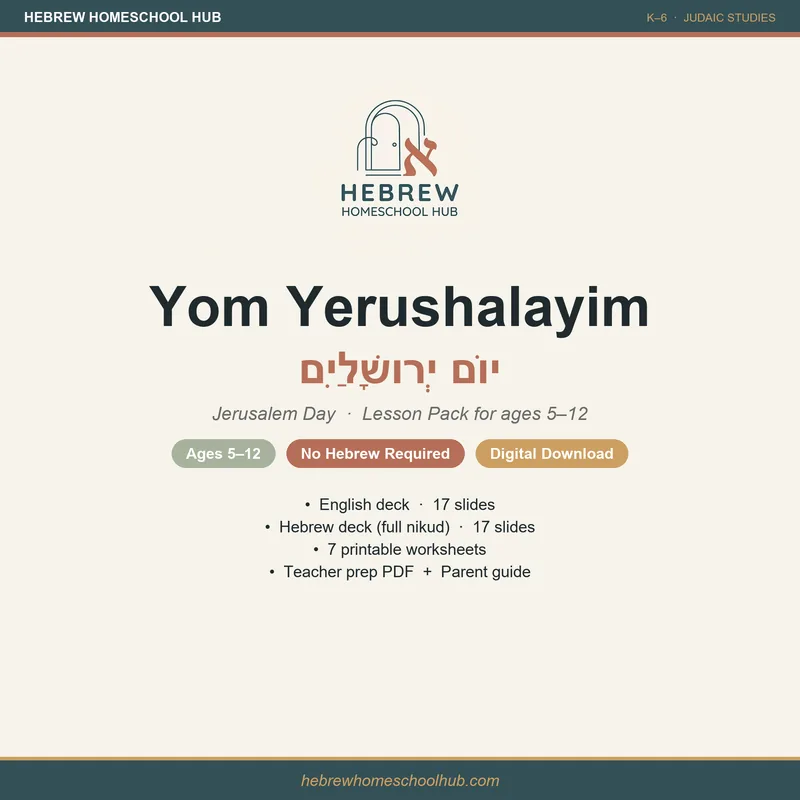
This blog post is a free, condensed lesson. The Hebrew Homeschool Hub Yom Yerushalayim lesson pack is the full thing — 17 slides, every gate with a real photograph, the Kotel, the celebration, a Hebrew vocabulary wall, a tefillah for Jerusalem, and 7 printable worksheets your child can do alongside the lesson. It also includes:
- An English presentation deck (17 slides, 16:9) with speaker notes — read the notes word-for-word as you click through.
- A vowelized Hebrew deck mirroring every slide, with full nikud.
- A printable worksheet pack — color the Kotel, trace the Hebrew gate names, match Hebrew to English, count, draw, reflect.
- A 17-page teacher prep PDF — every slide with its Hebrew speaker notes underneath, ready to print.
- An 11-page parent guide with lesson plans for 30 minutes, 60 minutes, or a half-day, plus a pronunciation cheat sheet and FAQ.
- A 1-page scope-and-sequence overview for your records.
Ready to teach it tonight?
Buy the Yom Yerushalayim pack on Etsy
Single-family digital download. Yours forever, free updates included.
Frequently asked questions
When exactly is Yom Yerushalayim in 2026?
The 28th of Iyar — that's Sunday, May 17, 2026. In future years, look up the Hebrew date on a Jewish calendar; the secular date moves with the lunar cycle.
Is Yom Yerushalayim a major or minor Jewish holiday?
It's a relatively young holiday, established by the Rabbinate of Israel after 1967. Some communities observe it with Hallel, festive prayers, and a celebratory meal; others mark it more quietly. There is no work prohibition. Practice varies — your family's minhag is welcome.
How is Yom Yerushalayim different from Yom HaAtzmaut?
Yom HaAtzmaut (5 Iyar) is Israel's Independence Day — the founding of the State in 1948. Yom Yerushalayim (28 Iyar) is Jerusalem's reunification day from 1967. They're three weeks apart on the calendar and pair beautifully. Many homeschool families teach them as a connected unit. We have a Yom HaAtzmaut pack as well.
Can I teach this if I don't read Hebrew?
Yes. Every Hebrew word in this post is transliterated. The Yom Yerushalayim pack also includes a pronunciation cheat sheet on page 7 of the parent guide. You can teach the whole lesson confidently without reading a single Hebrew letter — though by the end your child will recognize many.
What ages is this lesson for?
The pack is built for K–6 / ages 5–12 — early & middle elementary, with easy pacing for younger and older learners. Younger children (3–4) can listen along during the deck. Older children can dive deeper into the gate stories and do the worksheets independently.
What about Yom HaZikaron — Israel's Memorial Day — and the days between?
Yom HaZikaron (Memorial Day, 4 Iyar) precedes Yom HaAtzmaut and is a more solemn observance. We don't put it on a 1st-grade slide. If your child asks about Israeli siren sounds or solemnity in your community during this period, the Yom HaAtzmaut parent guide has a 1-sentence framing you can share.
More from Notes from the Hub
Rosh Hashanah for kids רֹאשׁ הַשָּׁנָה
Next on the Jewish-calendar horizon after Yom Yerushalayim: the High Holidays. A free 30-minute K–6 lesson for the shofar, apples and honey, Tashlich, and the two blessings in Hebrew + transliteration.
Read the lesson plan →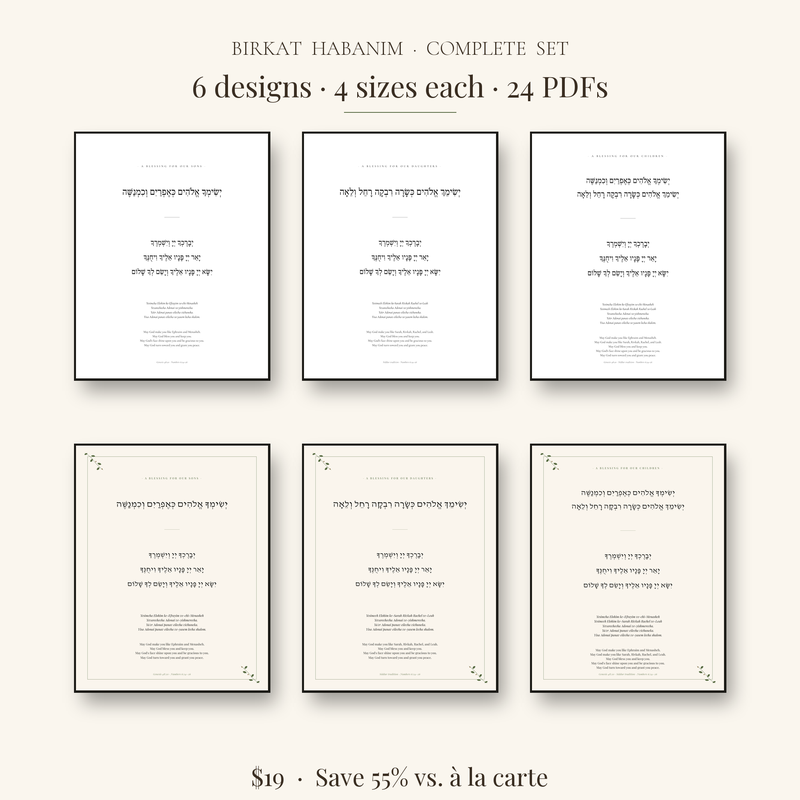
Blessing our children on Shabbat בִּרְכַּת הַבָּנִים
A free Friday night guide — the words for sons, daughters, and mixed families, when to do the blessing, and what to do if you don't read Hebrew.
Read the guide →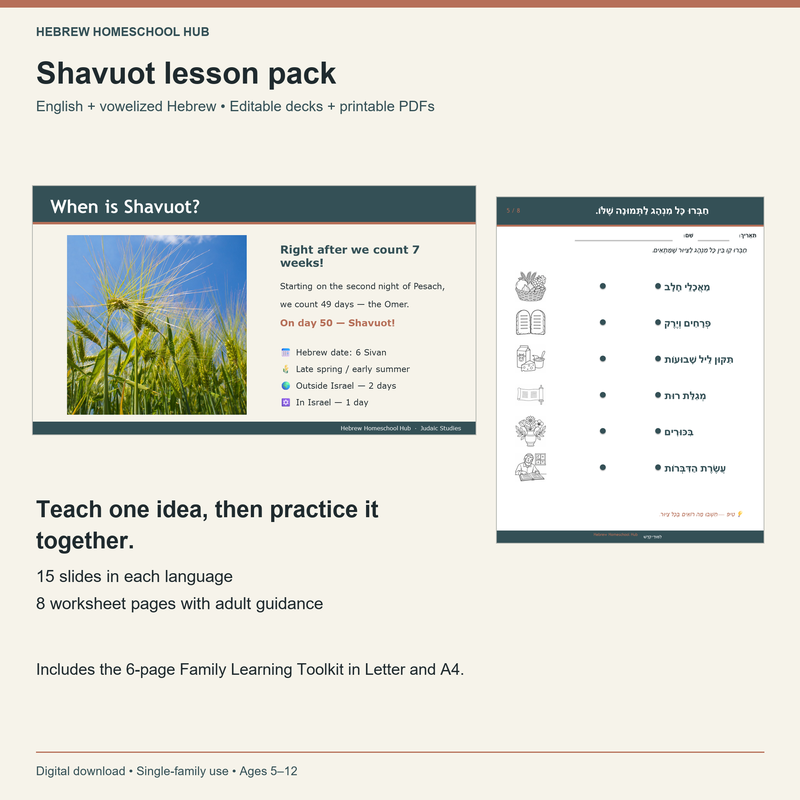
Counting the Omer with kids סְפִירַת הָעֹמֶר
A 49-day countdown that turns waiting into something. How the count works, the bracha, and four kid-friendly ways to make it visible.
Read the guide →Related packs in the series
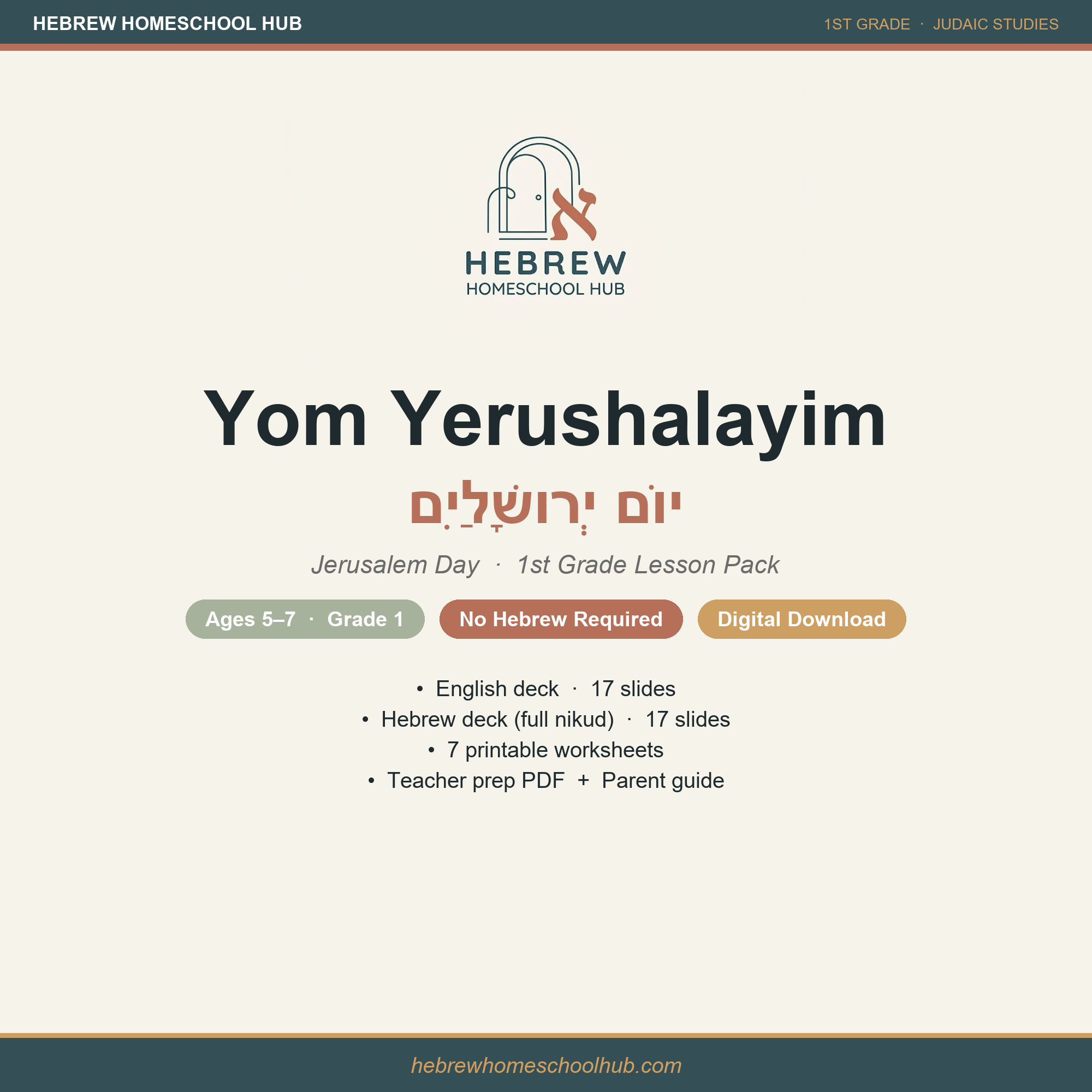
Yom Yerushalayim יוֹם יְרוּשָׁלַיִם
The full 17-slide pack — every gate, the Kotel, vocabulary, worksheets.
See the pack →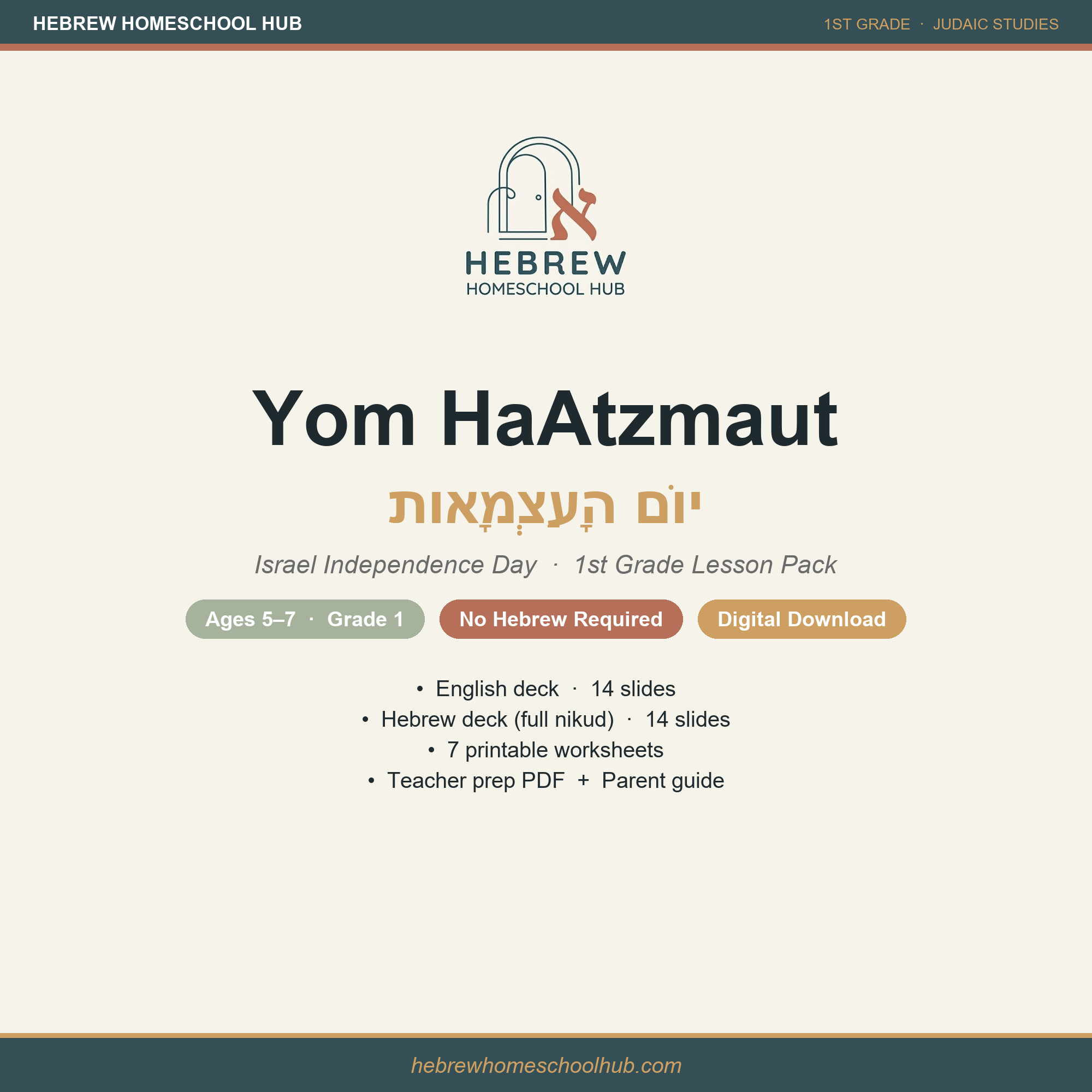
Yom HaAtzmaut יוֹם הָעַצְמָאוּת
Israel Independence Day — three weeks earlier on the calendar. The natural pair.
See the pack →