Blessing our children on Shabbat: a Friday night guide for parents who didn't grow up doing this.
Every Friday night, in Jewish homes across the world, parents place their hands on their children's heads and say a few short Hebrew sentences — the same sentences Yaakov used to bless his grandchildren more than three thousand years ago. It is the warmest, most personal moment in the whole Shabbat evening. This guide is for parents who want to start doing it — what to say, when to say it, what to do if you don't read Hebrew, and how to make it stick as a family tradition that lasts.
Posted May 14, 2026 · Reading time: ~6 minutes
What is Birkat HaBanim?
Birkat HaBanim (בִּרְכַּת הַבָּנִים) — literally "the blessing of the children" — is the traditional Friday-night blessing parents place on each of their children after candle-lighting and before the Shabbat meal. It's been part of Jewish family life for centuries. There's no formal halachic requirement to do it (it isn't a mitzvah from the Torah), but it's a near-universal custom in observant Jewish homes — and one that families who didn't grow up with it often adopt with the most love, precisely because they're choosing it on purpose.
The blessing has two parts. First, an opening line that depends on whether the child is a son or a daughter. Then the same closing — the Priestly Blessing from Numbers 6:24–26 — for both.
Where the words come from
The boy's blessing isn't ours; it belongs to Yaakov. In Genesis 48:20, Yaakov is on his deathbed in Mitzrayim, and his son Yosef brings him his two grandchildren — Ephraim and Menasheh — to be blessed. Yaakov puts his hands on the boys' heads and says: "By you shall Israel invoke blessings, saying: God make you like Ephraim and Menasheh." What he was promising is that for every Jewish generation that would ever live, parents would use his exact words to bless their sons. We've been doing it ever since.
The girl's blessing isn't biblical the same way — it doesn't appear as a single verse in the Torah. It's a siddur tradition: composed as the parallel to Yaakov's blessing, invoking our four matriarchs. It's at least several hundred years old in printed siddurim, and possibly older in oral tradition. Some siddurim print "may God make you like Sarah Rivkah Rachel and Leah" without conjunctions; others use the form "like Sarah, like Rivkah, like Rachel, and like Leah." Both are correct. Pick whichever your siddur uses.
The closing — the Priestly Blessing — is from Numbers 6:24–26, the words Hashem told Moshe to give to Aharon and his sons to use when blessing the people of Israel. It's the oldest known biblical text still in continuous liturgical use; archaeologists found it written on tiny silver scrolls from the seventh century BCE. The same words, on a Friday night in your kitchen, three thousand years later.
The words — for sons
יְשִׂימְךָ אֱלֹהִים כְּאֶפְרַיִם וְכִמְנַשֶּׁה
Yesimcha Elohim ke-Efrayim ve-chi-Menasheh.
"May God make you like Ephraim and Menasheh."
The words — for daughters
יְשִׂימֵךְ אֱלֹהִים כְּשָׂרָה רִבְקָה רָחֵל וְלֵאָה
Yesimech Elohim ke-Sarah Rivkah Rachel ve-Leah.
"May God make you like Sarah, Rivkah, Rachel, and Leah."
The shared closing — the Priestly Blessing
יְבָרֶכְךָ ה׳ וְיִשְׁמְרֶךָ
יָאֵר ה׳ פָּנָיו אֵלֶיךָ וִיחֻנֶּךָּ
יִשָּׂא ה׳ פָּנָיו אֵלֶיךָ וְיָשֵׂם לְךָ שָׁלוֹם
Yevarechecha Adonai ve-yishmerecha.
Ya'er Adonai panav eilecha vichuneka.
Yisa Adonai panav eilecha ve-yasem lecha shalom.
"May God bless you and keep you. May God's face shine upon you and be gracious to you. May God turn toward you and grant you peace."
How to actually do it
The mechanics are simple — and the simplicity is part of why this tradition has survived for thousands of years.
- After candle-lighting (or after returning from shul, or just before kiddush — whatever fits your family rhythm), call your children over one at a time. Birth order is traditional but not required.
- Place both hands gently on top of your child's head. If your child is taller than you, one hand works. If you're holding an infant, one hand on the baby's head is fine.
- Say the opening blessing for sons or daughters (above). If you have both sons and daughters, say each the appropriate one when it's their turn.
- Say the Priestly Blessing over each child after their opening.
- Optional but lovely: add a personal sentence at the end — "And may you always know how loved you are", or whatever feels true that week. The blessing is sacred; the personal note is yours.
- A kiss on the head closes the moment. Sit down. Eat dinner.
Total time for one child: about 90 seconds. For a family of four, around 4 minutes. Short enough for any Friday night, long enough that everyone in the room remembers it later.
What if you don't read Hebrew?
Two paths, both legitimate:
Path one — start in English, layer in Hebrew over time. Use the English translation above for the first several months. As you say the blessing every week, you'll start picking up the Hebrew rhythms naturally. Pick one phrase you like — maybe "Yevarechecha Adonai" — and say that one phrase in Hebrew while keeping the rest in English. Add another phrase a month later. By the end of a year, you'll be doing the whole blessing in Hebrew without consciously deciding to.
Path two — read it phonetically every week from a printed copy. Print the transliteration (the italic English-letter version above) on a card. Tape it inside a kitchen cabinet door, or to the back of your siddur. Read it aloud each Friday. After a few months, you won't need the card. Many parents go this route specifically because the transliteration helps the pronunciation lock in correctly from the start.
Either path leads to the same place. There is no version of "doing it wrong" except not doing it.
Want the blessing on your wall?
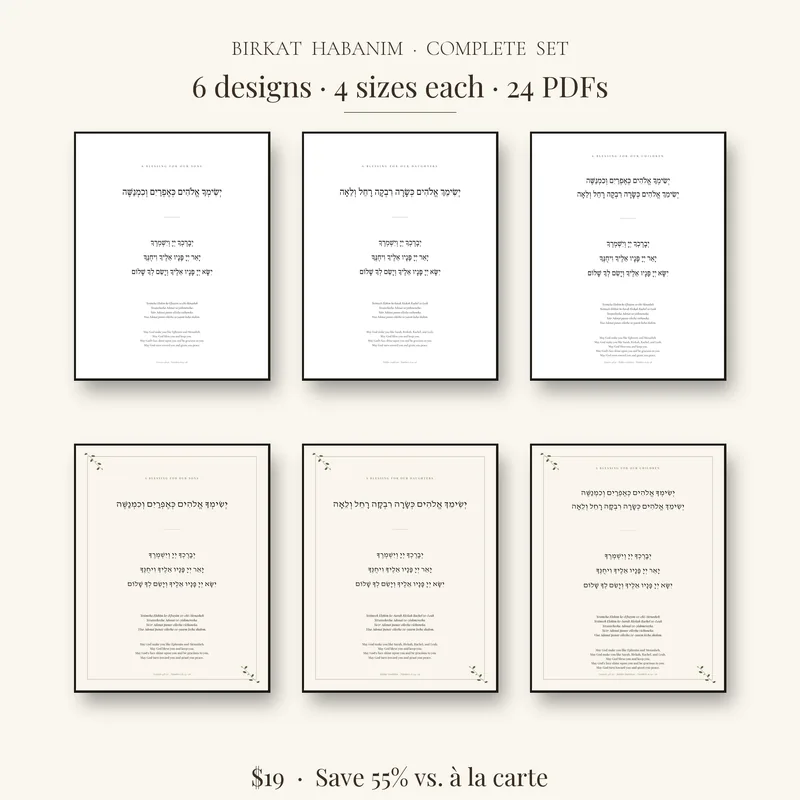
The full Birkat HaBanim — the Hebrew, the transliteration, and the English translation — is also available as a printable wall art series. Six designs (modern minimalist or warm traditional, in son / daughter / mixed-family versions), four print sizes each, instant download. Many families hang the print in the dining room — both as a reminder to do the blessing every week and as a beautiful piece of Hebrew typography in the home.
Hebrew vocabulary to introduce
| Word | Hebrew | Say it like |
|---|---|---|
| Birkat HaBanim (the children's blessing) | בִּרְכַּת הַבָּנִים | beer-KHAT ha-ba-NEEM |
| Shabbat | שַׁבָּת | sha-BAHT |
| Bracha (blessing) | בְּרָכָה | b'ra-KHA |
| Shalom (peace) | שָׁלוֹם | sha-LOME |
| Adonai (the Name we say) | אֲדֹנָי | ah-doe-NIE |
| Yevarechecha (may He bless you) | יְבָרֶכְךָ | y'va-re-khe-KHA |
| Veyishmerecha (and keep you) | וְיִשְׁמְרֶךָ | v'yish-m'RE-kha |
| Sarah Rivkah Rachel Leah (the matriarchs) | שָׂרָה רִבְקָה רָחֵל לֵאָה | sa-RAH riv-KAH ra-KHEL le-AH |
| Ephraim, Menasheh (Yosef's sons) | אֶפְרַיִם, מְנַשֶּׁה | ef-RA-yeem, m'na-SHEH |
Why families pick this up — even ones that didn't grow up with it
If your family is new to Friday-night observance, Birkat HaBanim is one of the easiest entry points. There's no preparation. There's no purchase required. There's no halachic question about whether you're doing it "right." Two hands, six sentences, ninety seconds.
And it accumulates. The first Friday is awkward. The third Friday is comfortable. By the tenth Friday, your kids start drifting toward the candles automatically when the time comes. By the fiftieth Friday — your child will know the blessing by heart. They'll also know that this is something their family does every single week, no matter what kind of week it was. That continuity is the gift Yaakov was actually giving when he blessed Ephraim and Menasheh — not just the words themselves, but the certainty of who would say them and to whom, every Friday night, forever.
If your child resists at first
Some kids — especially older ones who feel the strangeness of a new ritual — will roll their eyes the first few times. That's fine. Don't argue. Don't explain. Just keep doing it. The eye-rolling is almost always a phase that lasts three or four weeks; once the child realizes the blessing is happening every Friday whether they're enthusiastic or not, the resistance fades and the comfort takes over.
For very young kids (under 3), the touch is the whole experience — they don't yet care about the words. Place your hand on their head, say the blessing in whatever language is easiest, kiss them, send them on their way. The words will mean things to them later.
Frequently asked questions
Do I have to know Hebrew to bless my children on Friday night?
No. The blessing works in any language — what matters is the intention and the act of placing your hand on your child's head. If you want to use the Hebrew, this guide includes a full transliteration. Many families say one line in Hebrew (the part they know) and the rest in English. Over weeks and months, the Hebrew comes naturally just from doing it.
When in the Friday night sequence does Birkat HaBanim happen?
Most commonly: after candle-lighting and before sitting down to dinner. Some families do it after returning from shul; others just before kiddush at the table. There is no single right moment — pick the time that works for your family and stick with it. The consistency matters more than the timing.
What's the difference between the boy and girl blessings?
The opening line is different. Sons receive the words Yaakov said about Yosef's children — Yesimcha Elohim ke-Ephraim ve-chi-Menasheh, "May God make you like Ephraim and Menasheh." Daughters receive a parallel siddur blessing invoking the four matriarchs — Yesimech Elohim ke-Sarah Rivkah Rachel ve-Leah, "May God make you like Sarah, Rivkah, Rachel, and Leah." Both then receive the same Priestly Blessing from Numbers 6:24–26.
What if we have both sons and daughters?
Bless each child individually with their gendered opening line, then say the Priestly Blessing once over each one (or once over the whole family). Most parents go child by child in birth order. The whole sequence takes 90 seconds for one child, maybe 4 minutes for a family of four — short enough for any Friday night, long enough to feel like a real moment.
Where do I put my hands?
The traditional gesture is both hands on top of the child's head. If your child is too tall — or if you have an infant in your arms — one hand on the head also works. The physical contact is part of the blessing; the words are part of the blessing; both together are what makes it Birkat HaBanim.
Can grandparents do this too?
Yes — and many families pass the role around. When grandparents are visiting, the grandparent gives the blessing. Some families have both parents bless together (one hand each on the child's head). Some single-parent families have the parent give the blessing alone. There's no "who has to do it" rule — only "who's there to do it tonight."
Related from the Hub
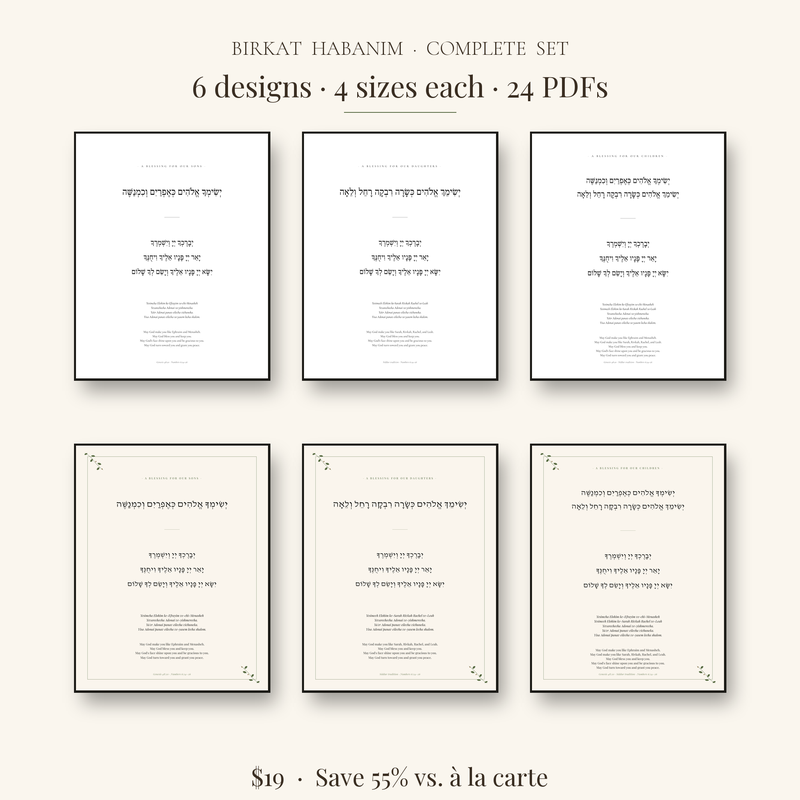
Birkat HaBanim wall art series
The full blessing — Hebrew + transliteration + English — as printable wall art. Six designs, four sizes each, instant download.
See the wall art series →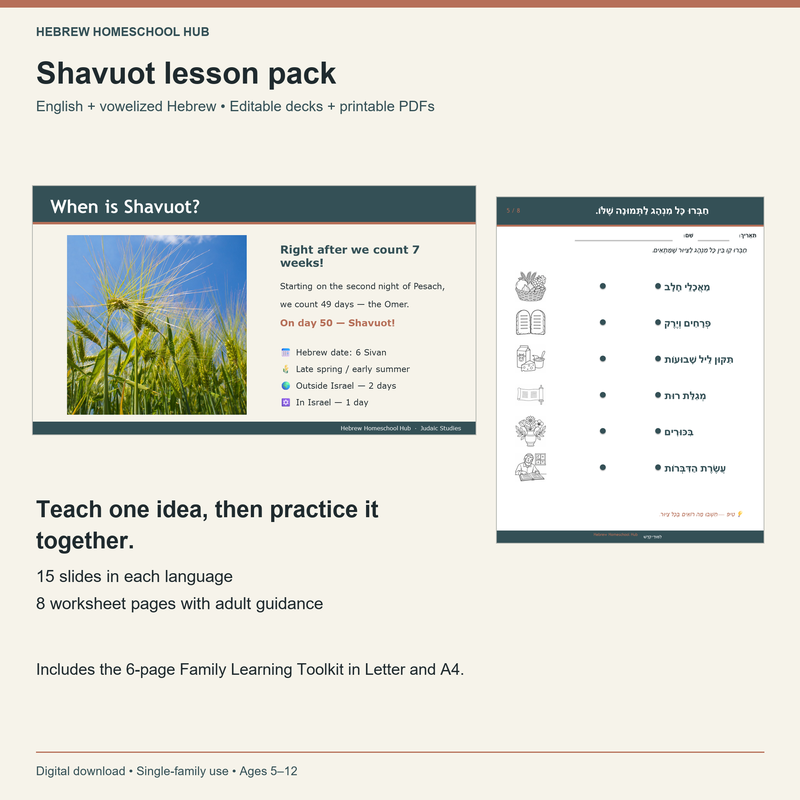
Shavuot lesson pack חַג הַשָּׁבוּעוֹת
Brachot for Shabbat covered as part of the holiday's customs slides. The natural next step if your child loves the Friday night blessing rhythm.
See the Shavuot pack →